
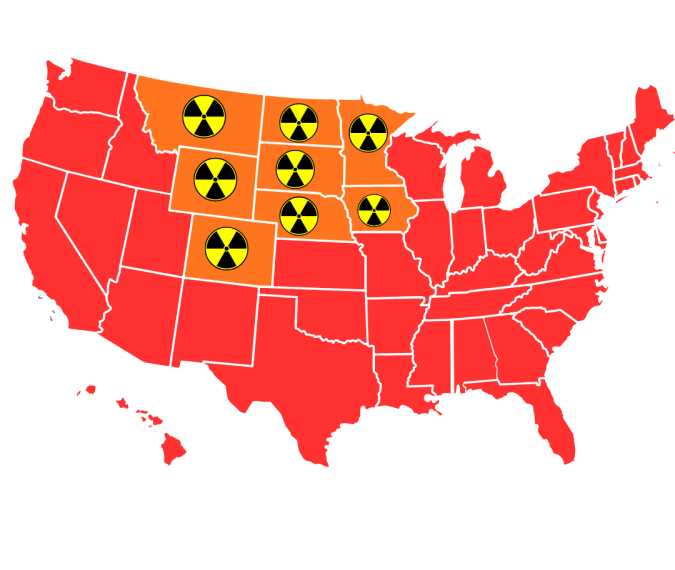
Eight most dangerous US states to be in if WW3 breaks out
Concerns about a potential global conflict have resurfaced following recent military action involving the United States and Israel targeting Iran. The strikes reportedly resulted in the death of Iran’s Supreme Leader, Ayatollah Ali Khamenei, along with hundreds of others, according to regional reports.
The operation, which took place on 28 February, was described by US President Donald Trump as an effort to prevent Iran from developing nuclear weapons. In response, Iran launched retaliatory strikes targeting Israel and several Gulf nations with US ties, including Bahrain, Qatar, Kuwait, and the United Arab Emirates.
As tensions escalate, many are questioning what a broader conflict could mean — and whether it could spiral into a third world war.
Could Any Country Truly Be Safe?
Security analysts often point out that geographically remote and politically neutral nations — such as Antarctica, Iceland, New Zealand, and Argentina — might face comparatively lower risks in a large-scale war.
However, experts stress that in the event of nuclear conflict, no location would be completely shielded. Fallout, food contamination, disrupted supply chains, and long-term radiation exposure would likely affect the entire globe.
What About the United States?
A previous assessment by Newsweek examined which US regions might face the greatest danger in the event of a nuclear strike targeting missile silos located in the American heartland.
The study focused on potential attacks on intercontinental ballistic missile (ICBM) sites in:
Colorado
Wyoming
Nebraska
Montana
North Dakota
It’s important to note that the analysis was based on a simulation conducted months before the recent escalation with Iran. The model calculated projected radiation exposure levels over four days, measuring cumulative ionizing radiation in grays (Gy).
John Erath, Senior Policy Director for the Center for Arms Control and Non-Proliferation, emphasized that while communities near military installations and missile facilities would likely experience the most immediate and severe impact, the consequences of any nuclear detonation would extend far beyond those areas.
He explained that radioactive fallout does not respect state boundaries and could contaminate water supplies, agricultural land, and infrastructure nationwide.
States Potentially Most at Risk
Using fallout projection maps from Scientific American, analysts identified eight states that could face the highest radiation exposure risk if missile silos in the Midwest were targeted:
Montana
Wyoming
Colorado
Nebraska
South Dakota
North Dakota
Iowa
Minnesota
These states are geographically closest to several key missile installations, which could make them more vulnerable in such a scenario.
States Considered Relatively Safer
On the other hand, areas further from central missile fields were projected to face comparatively lower direct exposure risks. The states identified as relatively safer include:
Maine
New Hampshire
Vermont
Massachusetts
Rhode Island
Connecticut
New York
New Jersey
Pennsylvania
Delaware
Maryland
District of Columbia
Virginia
West Virginia
North Carolina
South Carolina
Georgia
Florida
Alabama
Mississippi
Tennessee
Kentucky
Ohio
Indiana
Michigan
Still, experts caution that “safer” is a relative term. In a full-scale nuclear conflict, long-term environmental, economic, and humanitarian impacts would likely affect every region in the country.

