Trump becomes first sitting US president to appear on a coin as Mint releases $1 piece
A new $1 coin featuring US President Donald Trump has entered circulation in the United States, creating an unusual piece of American currency and a potentially sought-after souvenir for collectors and visitors.
The US Mint announced the release of the 2026 President Donald J. Trump $1 coin on Thursday. According to the Mint, the new coins have begun entering circulation, while collectors can also purchase specially packaged rolls and bags directly through official Mint sales channels.
A roll containing 25 coins is being offered for $61, while bags of 100 coins are priced at $154.50.
The release is notable because Trump is the first serving US president to have his portrait placed on an American coin intended for general circulation.
Despite being commonly described as a "golden dollar" because of its appearance, the new $1 coin does not contain actual gold. Its composition is predominantly copper (88.5%), combined with zinc, manganese,, and nickel.
The coins were produced at the Philadelphia Mint and do not carry a mint mark.
A Special Version for America's 250th Anniversary
Coin collectors will have another, considerably rarer version to look out for.
A total of 250,000 Trump dollar coins were struck on July 4 with a special "July 4th" privy mark. These coins have been distributed among the rolls and bags being offered by the US Mint, adding an element of chance for buyers hoping to obtain one.
The coin itself incorporates imagery connected to the 250th anniversary of American independence.
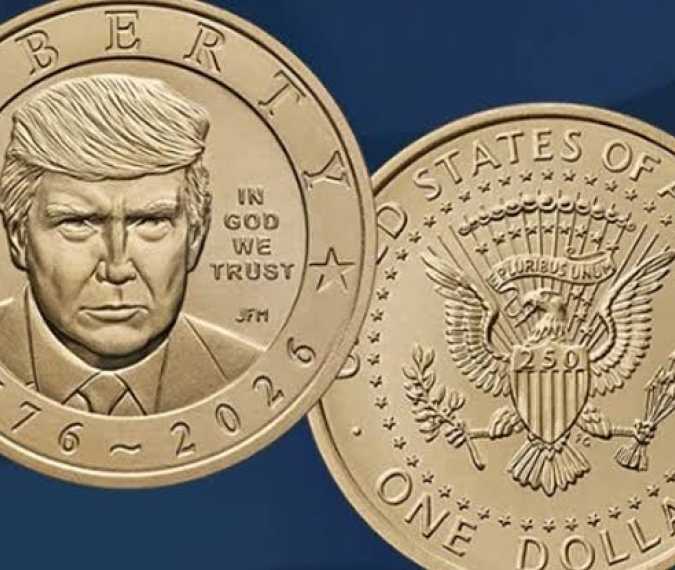
US Mint Chief Engraver Joseph Menna designed the obverse using an official White House photograph as the basis for Trump's portrait. The president is depicted looking almost directly toward the viewer.
The design is accompanied by the words "LIBERTY" and "IN GOD WE TRUST," along with the dates 1776–2026.
On the opposite side is the Presidential Seal, based on a design originally sculpted by former US Mint Chief Engraver Frank Gasparro. For the anniversary edition, the number "250" has been incorporated into the eagle's shield, referencing 250 years since the Declaration of Independence.
Will Travelers Actually Find One?
For travelers visiting the United States in 2026, finding a Trump dollar coin in ordinary change could be more difficult than the announcement might suggest.
Dollar coins are legal tender, but Americans generally rely much more heavily on $1 banknotes. As a result, dollar coins are encountered less frequently during everyday purchases than common denominations such as quarters, dimes and nickels.
That relative scarcity in day-to-day transactions could make the new coin an interesting keepsake for international visitors, particularly during America's 250th anniversary celebrations.
Not Quite the First Living President on a US Coin
Trump's appearance on circulating currency has an important historical distinction, but he is not the first living American president ever depicted on a US coin.
That distinction dates back a century.
In 1926, President Calvin Coolidge appeared together with George Washington on a half-dollar coin produced to commemorate the 150th anniversary of American independence.
Coolidge was president at the time, but the 1926 half dollar was issued as a commemorative coin rather than as an ordinary circulation coin. The Trump dollar therefore represents a different milestone: a coin depicting a sitting president that is intended to circulate as money.
The Coin Has Also Sparked Controversy
The decision has sparked legal and artistic debate.
American law generally restricts the appearance of living individuals on US coins. The administration's authority for the Trump dollar instead stems from the Circulating Collectible Coin Redesign Act of 2020.
The legislation, signed during Trump's first presidential term, provides for special $1 coin designs associated with the United States' semiquincentennial celebrations in 2026.
Questions were also raised during the design process.
The US Commission of Fine Arts reportedly favored a profile portrait of Trump and proposed a different treatment of the eagle. Those recommendations were ultimately not incorporated into the finished coin.
Meanwhile, the Citizens Coinage Advisory Committee, which ordinarily reviews proposed US Mint coin designs, declined to review the Trump design.
Whatever the debate surrounding its creation, the coin is likely to attract attention from collectors—and perhaps from travelers checking their change—during a year in which the United States is celebrating 250 years since independence.