
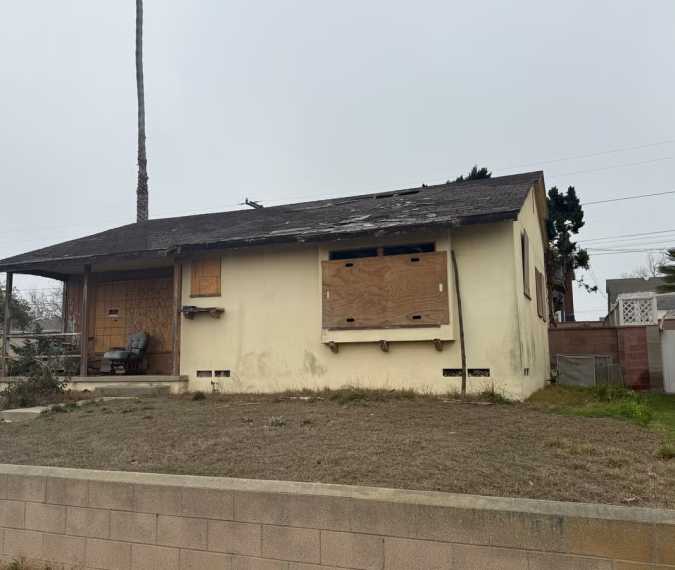
California’s housing market is so out of control that even a small, burned-out home goes for $1 million
California’s housing affordability crisis continues to produce surprising headlines, with a severely damaged home in the Los Angeles area recently selling for around $1 million despite being completely unfit for occupancy.
The property, located in Torrance, a city within the greater Los Angeles metropolitan area, drew attention for its condition. The three-bedroom, two-bathroom ranch-style house had suffered major fire damage, including a large hole in the roof, and remained boarded up after sitting vacant for more than a year.
Even so, strong buyer demand pushed the sale price beyond expectations. According to real estate listings, the 1,140-square-foot home sold slightly above its asking price, demonstrating just how competitive California’s property market has become.
Rhett Winchell, chief financial officer at NDA Real Estate, previously handled an auction involving the property and said interest in the home was unexpectedly high. He noted that the neighborhood itself played a major role in attracting buyers, emphasizing Torrance’s reputation as a desirable area.
The sale reflects a much larger issue affecting the state. Housing analysts have repeatedly described California as facing a severe shortage of homes, a problem that has driven prices upward for decades. Data from the California Legislative Analyst’s Office indicates that the median cost of a mid-range home in the state recently reached approximately $775,000—more than double the national figure.
The Torrance home had remained empty since a fire broke out in February 2024. Reports indicate the residence contained significant clutter and that the blaze may have started when material near a floor heating vent ignited. An elderly resident escaped through a window and survived the incident, though he later passed away. The home was subsequently sold through a probate auction.
During that auction, the property attracted bids approaching seven figures, ultimately surpassing $1 million once additional fees were included. The buyer later resold the property this month.
Industry observers suggest the sale price had less to do with the damaged structure itself and more to do with the land beneath it. In neighborhoods where renovated homes frequently sell for $1.5 million or more, the lot alone represented substantial value.
California officials have attempted to address the housing shortage through legislation aimed at expanding residential development. Among the reforms are measures encouraging the construction of accessory dwelling units, commonly known as ADUs—secondary housing structures added to existing residential lots.
Some researchers estimate that the state may need more than 2 million additional housing units to meet demand. However, experts remain divided on whether recent policy changes are producing meaningful results.
Eric McGhee, a senior fellow and policy director at the Public Policy Institute of California, said accessory dwelling unit reforms have shown promise and now account for a sizable share of residential construction activity. Still, he questioned whether these additions are significantly increasing housing supply, noting that some are used as offices, recreational spaces, or short-term rental properties rather than as permanent homes.
McGhee also pointed to long-standing local development restrictions as a major contributor to the crisis. Rules designed to preserve community character and environmental goals, he argued, may have unintentionally slowed housing expansion across the state.
He believes long-term solutions will require faster permitting systems and more efficient building techniques, including modular construction methods.
According to McGhee, California’s housing challenges have developed over many decades, making solutions unlikely to deliver immediate results.
“This is a problem built over time,” he said, “and solving it will take time as well.”