

Scientists calculate who will win the World Cup and there's a clear favorite
With the 2026 FIFA World Cup just around the corner, excitement is building as fans across the globe debate which nation will lift football's most prestigious trophy. While supporters have their own opinions, a team of researchers believes data and artificial intelligence may offer the best prediction.
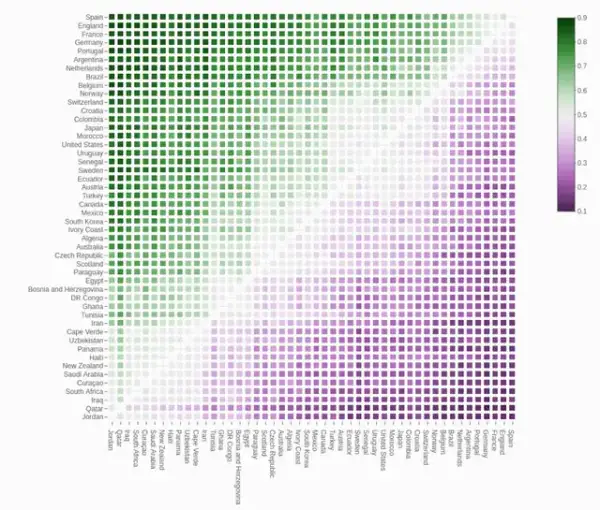
Scientists from the University of Innsbruck have developed a statistical model designed to estimate each team's chances of winning the tournament. By analyzing a range of factors, including bookmaker odds, player ratings, team market values, and historical performance data, the researchers produced a ranking of the nations most likely to succeed.
The tournament, which kicks off on June 11, will be hosted jointly by the United States, Canada, and Mexico. For the first time in World Cup history, 48 national teams will compete for the title across North America.
University of Innsbruck
According to the study, Spain enters the competition as the leading favorite. The researchers estimate that the Spanish national team has a 14.5% chance of winning the World Cup. England and France follow closely behind, each with a projected probability of 12.4%, while Germany is ranked fourth with an 11.2% chance.
To generate these forecasts, the research team combined multiple sources of football data and fed them into a machine-learning model. The system was designed to simulate potential matchups throughout the tournament and estimate likely outcomes.
Researchers explained that the algorithm predicts the expected number of goals in every possible match involving the 48 participating teams. By running countless simulations, the model identifies which teams are most likely to progress through the competition and ultimately claim the trophy.
Based on these calculations, the ten teams with the strongest chances of winning the 2026 FIFA World Cup are:
1. Spain
2. England
3. France
4. Germany
5. Portugal
6. Argentina
7. Netherlands
8. Brazil
9. Belgium
10. Norway
Despite the rankings, the researchers emphasize that predicting a World Cup winner remains highly uncertain. Even the highest-ranked team has less than a one-in-five chance of lifting the trophy.
Andreas Groll, a co-author of the study from TU Dortmund University, noted that football's unpredictability makes forecasting so challenging. While Spain currently tops the projections, the combined probability of all other teams winning remains significantly higher.
Rather than focusing solely on identifying the champion, the researchers are interested in evaluating whether the teams expected to advance deep into the tournament actually perform as predicted once the competition begins.
As fans prepare for a month of football across North America, the study offers an intriguing, data-driven glimpse into how the 2026 World Cup could unfold—but, as history has shown, surprises are never far away on football's biggest stage.