The 19 safest places in the UK if WW3 breaks out — and the one area to avoid
Lists naming Britain’s “safest” places during a global conflict offer a reassuringly simple answer to a complicated question. But an old map of hypothetical nuclear strikes cannot establish where people would be safe in a future war.
The widely circulated list of 19 UK locations traces back to a property company’s exercise in 2017. Understanding its origins—and its limitations—is essential before treating it as practical advice.
Where the list came from
Estate agency eMoov produced a map examining hypothetical nuclear strikes on 20 major British cities. Contemporary reporting described locations outside the map’s assumed impact zones, including coastal towns and more remote areas. It was a property-company exercise, rather than a government emergency-planning assessment.
A subsequently published version lists these 19 places:
The UK's safest locations identified in case of WW3
Cornwall
Weymouth
Folkestone
Dover
Margate
Clacton-on-Sea
Felixstowe
Brixworth
Bideford
Aberystwyth
Skegness
Isle of Anglesey
Barrow in Furness
Lancaster
Whitby
Carlisle
Dumfries
Berwick-upon-Tweed
These are the locations reproduced in the published list, not a verified ranking of present-day safety. They also mix towns and cities with much larger areas, such as Cornwall.
Why the military context matters
One reason to question simple geographical rankings is that significant defense facilities are not confined to the largest cities.
HM Naval Base Clyde, commonly known as Faslane, houses Britain’s nuclear deterrent submarines. Nearby Coulport supports key elements of the Trident missile system. Those confirmed roles explain why the area features in discussions about military infrastructure. Still, they do not establish that the entire Clyde region is uniquely dangerous or predict where an attack would occur.
Barrow-in-Furness illustrates another limitation: despite appearing on the circulated list, it is the construction site for the UK’s nuclear-powered submarines. Its inclusion should therefore not be interpreted as evidence that it lacks strategic significance.
What households can usefully do now?
The government’s emergency-preparedness advice provides a firmer basis for action than speculative maps. Its Be Ready campaign recommends preparing for three days of disruption, with drinking water, food that does not require cooking or refrigeration, a torch, warm clothing, a charged power bank and a battery-powered or wind-up radio. Supplies should reflect each household’s needs and can be built up gradually.
Such preparations help with emergencies, including power cuts and water outages. The advice should not, by itself, be read as a prediction that world war is imminent.
The 2017 map is best understood as a historical exercise built around particular assumptions. It cannot provide the certainty implied by a “safest places” headline—or a reliable basis for deciding where to move.
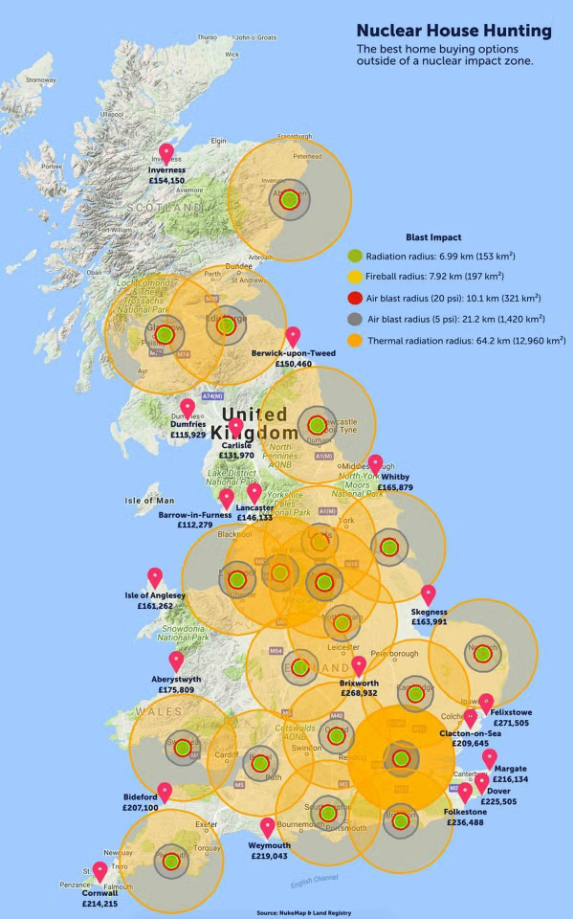
Online estate agency Emoov pulled together a list of 19 of the safest places in the UK if WW3 starts(Image: EMOOV)