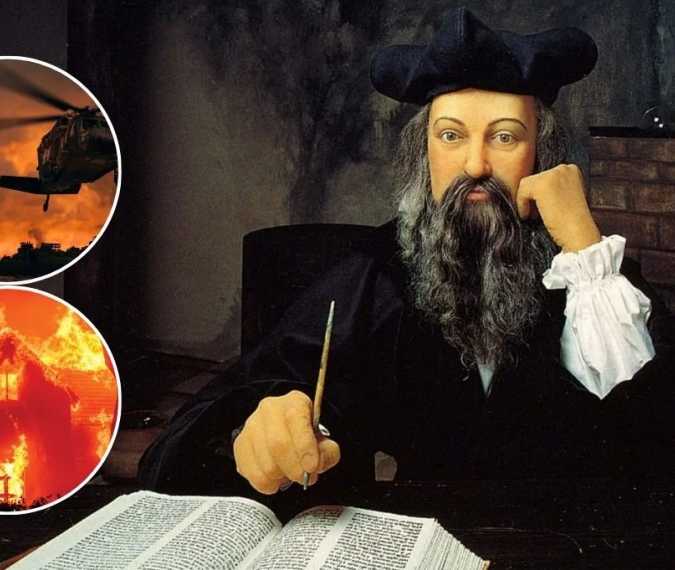
Nostradamus made five chilling predictions that experts believe were for 2027
As 2027 draws closer, Nostradamus is returning to the headlines. Verses attributed to the sixteenth-century French astrologer are being linked to everything from financial turmoil to hidden treasure.
One important detail behind these stories: the passages being discussed do not explicitly identify 2027. Their connection to the coming year comes from modern interpretations, rather than a dated forecast. Sky HISTORY’s own discussion acknowledges that his quatrains do not name the year.
So, what are the five claims attracting attention—and how much do the verses actually tell us?
Could an old treasure mystery finally be solved?
One interpretation connects a passage about treasure near an oak tree with the legends surrounding Oak Island, off Canada’s Atlantic coast.
The verse describes concealed riches and a fatal injury associated with their discovery. That combination has encouraged comparisons with stories of a curse surrounding the island’s treasure hunt.
However, an oak tree is not enough to establish a geographical connection. The passage does not name Oak Island or provide a discovery date. The association remains a theory built around similar imagery.
A possible turning point involving Iran and Turkey
Another passage refers to Persia and Trebizond, names associated with present-day Iran and the Turkish city of Trabzon.
Its references to weapons, fire and someone arriving from Persia have inspired speculation about developments around the Black Sea. Some commentators have suggested that the words could point to diplomatic talks in Turkey.
A peace summit, however, is an interpretation added by modern readers. The verse itself does not describe negotiations or announce an agreement. Its language leaves the nature of the supposed event unclear.
An unexpected challenge in French politics
A verse mentioning the “Dauphin”—the traditional title of the French heir apparent—has been interpreted as a warning about a political successor facing a challenge.
Modern readings replace the royal figure with someone seeking power in contemporary France. From there, the passage becomes a possible story about electoral upheaval.
That requires several assumptions. The wording does not identify a modern candidate, political party, or election result.
Financial trouble and mounting debt
The economic prediction centers on references to gold, silver, debt, and missing financial documents. Readers have connected those images with fears of a major financial crisis.
There is also an inconsistency in the proposed link to 2027. Some interpretations select verses numbered 27 to match the year, but the financial passage comes from Century VIII, quatrain 28. Sky HISTORY explicitly acknowledges this exception.
The imagery may evoke economic instability, but it supplies no reliable timetable for a crash.
Fire and a damaged natural world
The final claim concerns a passage describing fire crossing the sky and living things struggling to survive. It has been presented as a warning about extreme heat and destructive wildfires.
The text’s classification also deserves care. Although some coverage calls it a quatrain, the quoted lines appear in a six-line verse numbered 27 in collections of the Sixains. The fire imagery alone does not predict modern climate change or a particular wildfire season.
These interpretations offer mystery, drama, and plenty to debate. Their appeal also reveals how readily old, ambiguous language can be connected to present-day concerns. For readers looking ahead to 2027, they are best approached as speculative readings of historical texts, rather than dependable forecasts.