
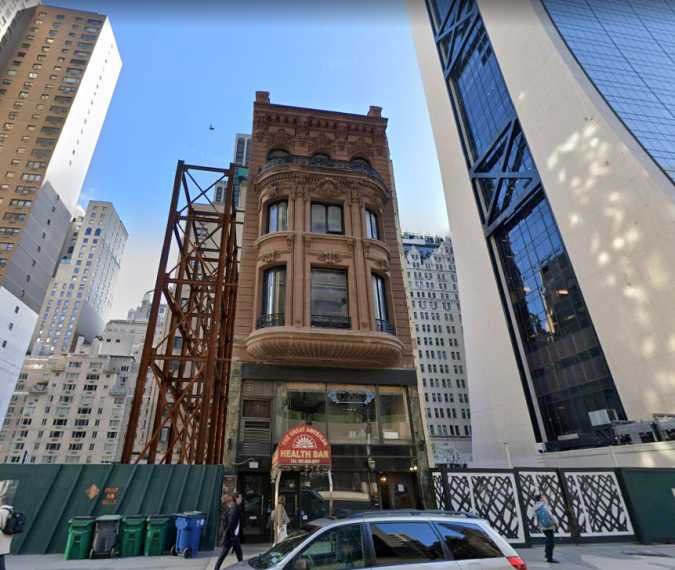
A $42 Million Sale Puts a Vanderbilt-Linked Manhattan Mansion at a Crossroads
A historic townhouse on Manhattan’s West 57th Street has become the latest acquisition in a development project that could transform its block. Sedesco has purchased the Schieffelin-Bowne House at 35 West 57th Street from the Soloviev Group for $42 million. The developer’s legal adviser, Herbert Smith Freehills Kramer, confirmed the transaction.
For preservation advocates, the sale renews urgency to protect a building that connects modern Midtown to its residential past. For Sedesco, it adds another property to a site the company has spent years assembling.
A larger development takes shape.
The purchase follows a series of nearby acquisitions stretching back more than a decade. According to Bisnow, Sedesco’s earlier purchases include properties on West 57th and West 58th streets. A 2021 application proposed a mixed-use development with 119 apartments and 158 hotel rooms.
Previous proposals envisioned a 63-story tower rising approximately 1,100 feet, with luxury residences, a hotel and a restaurant. Those figures describe earlier plans, however, rather than a confirmed final design for the enlarged site. The New York Post reports that updated plans are expected.
The distinction matters: the mansion’s acquisition advances the land assembly, but it does not establish exactly what will ultimately be built or when construction will begin.
The family history behind the address
Long before this stretch of Midtown became associated with luxury skyscrapers, it attracted wealthy New Yorkers building substantial private homes.
The Schieffelin-Bowne House dates to 1891. According to the architectural history site Daytonian in Manhattan, Margaret Vanderbilt Shepard gave the residence to her daughter, Maria Louisa, and son-in-law, William Jay Schieffelin, as a wedding present. The home later passed to businessman Samuel W. Bowne in 1899.
As commercial activity spread through the neighborhood, the building’s use changed. Its lower floors were adapted for retail, allowing the former residence to remain part of a streetscape increasingly shaped by businesses and larger buildings. That survival has made it a recognizable link to an earlier chapter of West 57th Street.
Preservation efforts continue amid uncertainty.
The community campaign Save57 is advocating preserving the mansion’s historic façade and defining architectural features. Its stated aim is to retain the elements that make the building a reminder of Midtown’s Gilded Age streetscape.
The precise demolition status is less clear. Commercial Observer reports that the city’s Department of Buildings has approved demolition plans. However, third-party trackers of city filings show a demolition application filed in early November 2026, with one listing it as awaiting examiner assignment and another showing no permit on record. Those records do not independently confirm that demolition is ready to proceed.
What is clear is that the sale has placed the property’s future at a critical point. The next stage will determine whether any of its historic architecture survives within the redevelopment—or whether the block loses another visible connection to the families and homes that once defined it.

